Chinese state-linked ownership across eleven Mediterranean
container terminals, assessed against NATO logistical exposure. Forty pages,
completed July 2026.
To what extent do Chinese commercial investments in Mediterranean port
infrastructure create strategic dependencies relevant to NATO logistics?
It is a question usually answered in one of two unsatisfying ways. Either
Chinese equity is treated as equivalent to Chinese control, which produces
alarm the corporate structures do not support. Or the absence of naval port
calls is treated as the absence of a problem, which ignores what commercial
concentration does on its own.
The answer, in three parts
High confidence. There is material commercial
concentration within a specific corporate perimeter, dominated by COSCO
Shipping Ports, and three positions carry high observational utility as a
function of their location.
Moderate confidence. That concentration has dependency
implications for European logistical resilience.
Not supported. Publicly available evidence does not
substantiate claims of routine PLA or PLAN operational use of any position
in the network. The commercial dependency argument is far better evidenced
than the direct military use argument, and the report says so.
The network
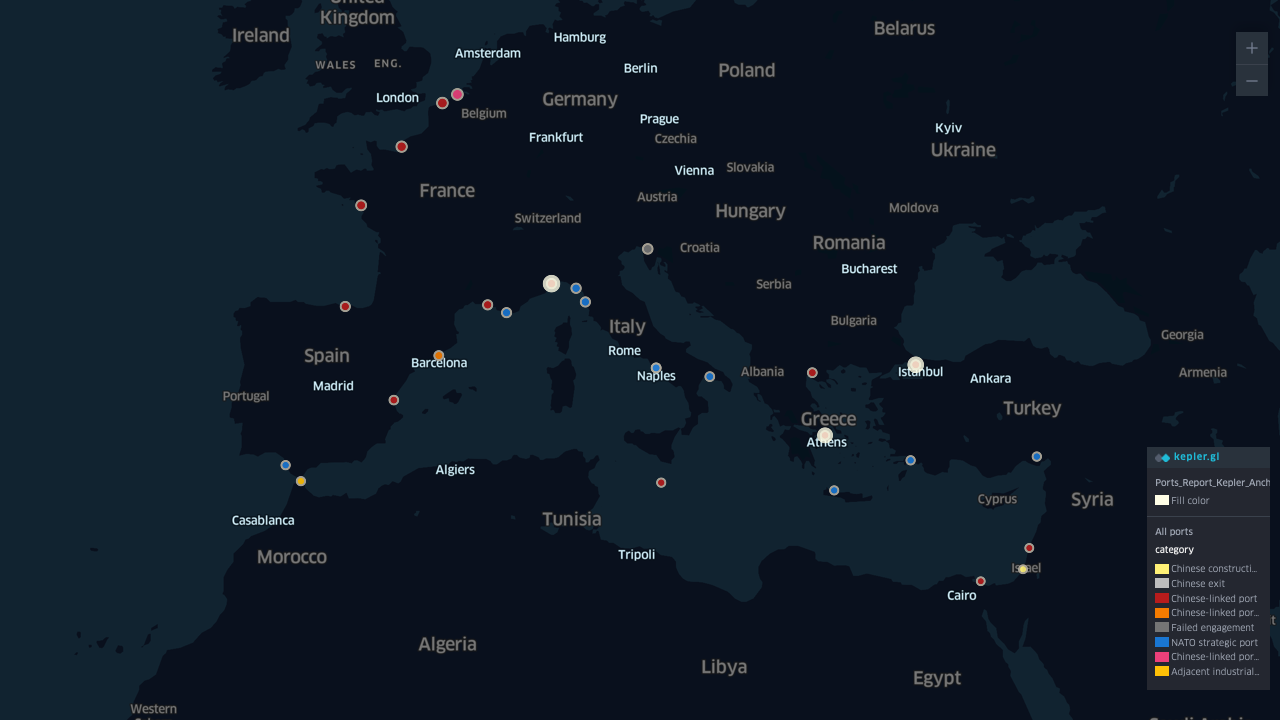
Figure 1. Chinese-linked Mediterranean and western
European port positions, plotted against NATO strategic ports, with
documented exits, failed engagements and adjacent industrial investment
shown as separate categories. Built in Kepler.gl from the study's own
ownership matrix, itself compiled from HKEX filings, operator disclosures
and corporate registries. Produced by Ethan Gallant, July 2026.
Eleven positions of analytical significance, across three ownership tiers,
five Chinese entities and seven jurisdictions.
Tier
Positions
Count
Tier 1 Majority ownership, direct board and operational authority
Piraeus, Valencia, Bilbao, Kumport
4
Tier 2 Significant influence, board seats and veto rights without control
Vado Ligure, Suez Canal Container Terminal, Fos-sur-Mer, Malta Freeport, Thessaloniki
5
Tier 3 Operational concession without controlling equity
Haifa Bay, now a mixed Tier 2 and 3 configuration after the July 2025 partial divestment
1
Separate category Hong Kong listed private operator, not SASAC controlled
Barcelona (BEST), held by Hutchison Port Holdings
1
The count rises to fourteen if the three Atlantic-coast
French terminals in the same China Merchants portfolio are included. They are
part of the same corporate network but excluded on geographical grounds.
Published figures for this network vary between roughly ten and fifteen
positions, and the variation is almost entirely a function of inclusion rules
like these, which is why the report states its own.
Five findings
Ownership is heterogeneous, not a bloc
Confidence: high
The four SASAC-controlled entities are ultimately subject to central
government oversight but maintain distinct corporate boards, separate
reporting lines and competing commercial priorities. Hutchison, Hong Kong
listed, has a qualitatively different relationship with Beijing. Treating
"Chinese-linked" as an undifferentiated category overstates the coherence of
the network.
Co-investment with Western operators is the dominant pattern
Confidence: high
APM Terminals holds majority operational stakes alongside COSCO at Vado
Ligure and at Port Said. CMA CGM holds significant minority stakes at
Valencia and Bilbao. The July 2025 sale of a 25 per cent interest in the
Haifa Bay terminal to Israel's Noy Fund extends the pattern into the
concession model.
The consequence is direct. Any assessment using Chinese equity share as a
proxy for operational control systematically overstates the extent to which
Chinese state direction can be exercised at terminal level.
The network is not expanding monotonically
Confidence: high on the trajectory, low on the interpretation
The Naples exit in 2016, the failed engagement at Trieste, Italy's
withdrawal from the Belt and Road Initiative in December 2023 and the
partial Haifa divestment in July 2025 form a pattern of contraction and
unrealised engagement. There have been no new Tier 1 acquisitions since
October 2021.
Whether that is a stable plateau or an early phase of contraction cannot
be established from the present evidence, and the report grades that
interpretation low rather than choosing the more
interesting reading.
Dependence operates at network level, not port level
Confidence: high
The 2024 Red Sea disruption is the natural experiment. Piraeus throughput
fell 7.8 per cent as Asia-Europe flows diverted. Over the same period
throughput rose 16.8 per cent at COSCO's Spanish terminals and 55.3 per cent
at CSP Zeebrugge.
The rerouted traffic never left the COSCO network. Dependence should
therefore be assessed across the corporate portfolio rather than at any
single terminal, because network-level flexibility keeps cargo inside the
same perimeter even as individual port dependence softens.
Operational and observational utility are independent variables
Confidence: high on the distinction
This is the distinction the report rests on, and collapsing the two into
a single "military utility" rating misstates every case where they
diverge.
Dimension
What it measures
Finding across the network
Operational
Capacity to move military materiel, host military vessels or supply state forces
Low or low to moderate at every case. No case rated high.
Observational
Structural access to maritime domain data, vessel identification and transit patterns, by virtue of location
Low at most cases. High at three: Kumport on the Bosphorus southern approach, Port Said at the northern entrance to Suez, and Haifa Bay, co-located with an Israeli naval facility.
Those three are also the cases most frequently invoked in
secondary reporting, usually without the distinction being drawn. Note the
separate grading: confidence that the observational potential exists is
high, because it is a structural feature of geography.
Confidence that it has been operationalised into intelligence flow to Chinese
state entities is low, and that gap is stated rather than
bridged.
Method
Confidence graded by dimension
Each case carries three separate confidence ratings:
commercial influence, military utility, and evidence of PLA operational
use. They are not collapsed into one, because the evidence supporting each
is qualitatively different. Piraeus, for instance, grades high, moderate
and low respectively. A single overall rating would have concealed exactly
the thing worth knowing.
Competing hypotheses, tested
The findings are set against the alternative
explanations that would have to hold for them to be wrong, rather than
presented as the only available reading. Ownership tiers, throughput
figures and shareholder structures are taken from primary corporate
filings, principally HKEX disclosures and operator releases, with the
source recorded per row.
What it does not show
It does not show military use. It does not establish what data, if any,
flows from these terminals to Chinese state entities. It cannot resolve
whether the network has plateaued or begun to contract. Each of those is
recorded as a limit on the finding rather than filled with the more
publishable inference.
Two positions where beneficial ownership could not be established from open
sources are recorded as intelligence gaps. Those two are the ones I would want
a reader to press me on, which is why they are here rather than buried in an
appendix.
The study is unpublished. It is available in full on request, and I am
happy to talk through the method with anyone assessing it.